


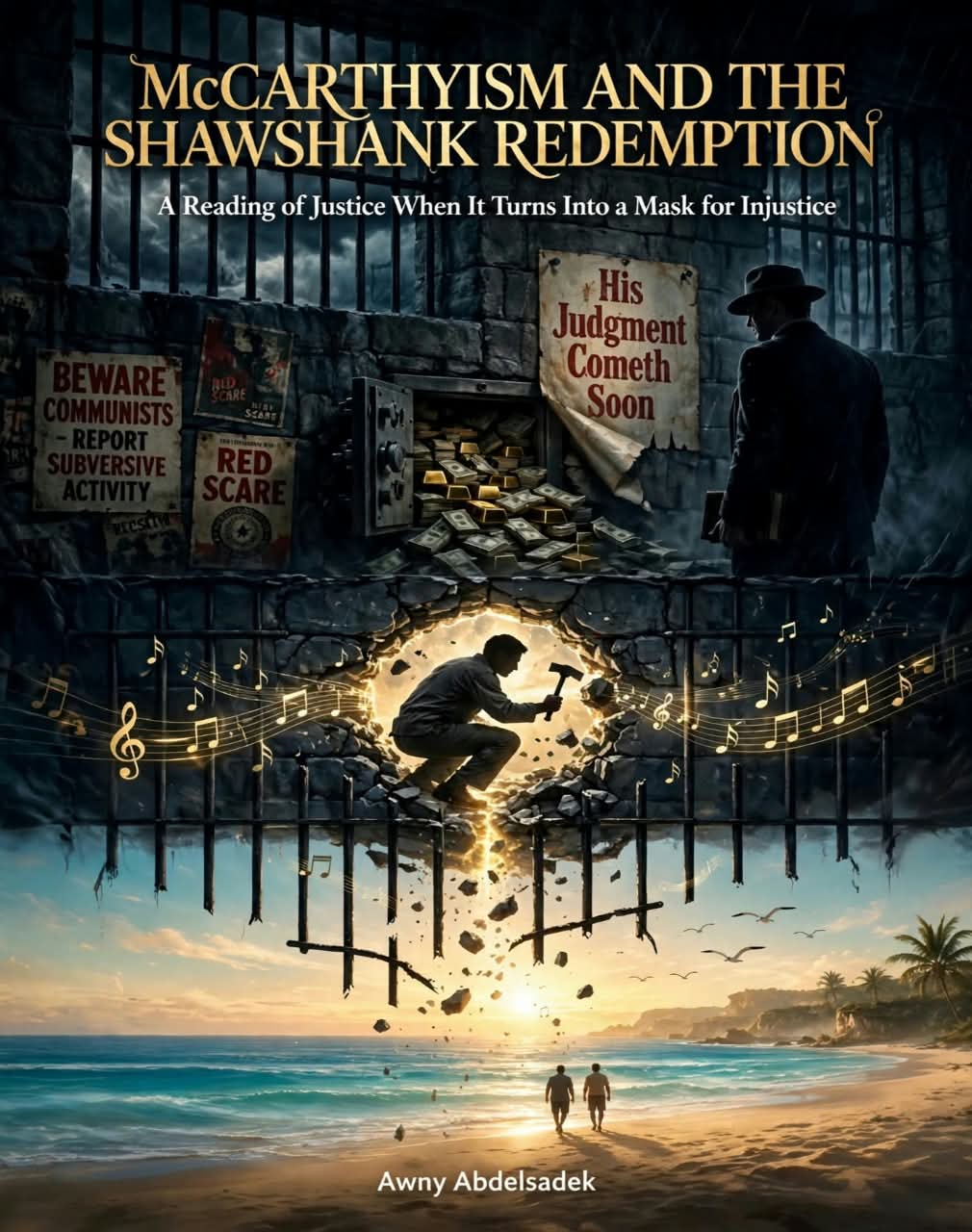
 McCarthyism and The Shawshank Redemption
A Reflection on Justice When It Becomes a Mask for Injustice
By Awni Abdel-Sadeq
There are films whose stories do not end when the final scene fades, nor do they disappear from our memories when the closing credits begin to roll. Instead, they linger in our consciousness, inviting reflection and opening new horizons through which we may better understand life, humanity, and society. The Shawshank Redemption stands among the finest examples of such rare cinematic works. It is far more than a story of imprisonment, punishment, and escape. It presents a parallel human world in which characters, events, and destinies intertwine, revealing the many faces of truth, justice, and freedom.
It is a film that strikes a deep chord within us, leaving behind a question that reaches far beyond the screen: How can justice, one of humanity’s noblest values, become an instrument in the hands of tyrants? And how can a law established to protect human beings become a means of stripping them of their rights and subjecting them to the cruelest forms of injustice?
This contradiction is embodied most vividly in Samuel Norton, the warden of Shawshank Prison, portrayed by Bob Gunton. Norton is a man who speaks in the name of God and proclaims the virtues of justice and discipline, while concealing behind this façade the most abhorrent forms of tyranny and corruption.
McCarthyism: When Fear Becomes the Law
The film’s events unfold from the late 1940s through the mid-1960s, a pivotal period that witnessed the early rise of the United States to a position of global dominance. Having emerged from World War II as one of the victorious Allied powers, America was poised to reap the rewards of victory and expand its growing political, military, and economic influence across the world.
The world was then living under the shadow of the Cold War, whose intensity continued to escalate between the United States and the Soviet Union. The latter had entered the age of nuclear testing in 1949. Meanwhile, in the East, the Korean War had erupted, while Mao Zedong had risen to the highest position of power in China, proclaiming a new communist regime that would transform the balance of power in the region and beyond.
Amid these sweeping transformations, the United States entered one of the darkest periods in its political history, as McCarthyism intensified, reaching its height in the early 1950s, particularly in 1952.
The country was gripped by political suspicion. Merely being suspected of communist affiliations could be enough to trigger investigations, persecution, and public disgrace. Raids and searches expanded in scope, reaching individuals from every social class and professional background, regardless of their standing, positions, or public reputation.
The declared objective was to purge government institutions and society of communist elements alleged to have infiltrated the American administration. Yet suspicion did not stop at government institutions. It spread to research centers, universities, and schools, targeting intellectuals, writers, artists, actors, playwrights, poets, singers, and members of the liberal professions.
Many found themselves facing accusations unsupported by credible evidence, or founded upon fabricated incidents and questionable testimonies. Countless individuals lost their jobs and livelihoods, while others were driven from their positions. Fear of being accused became more powerful than confidence in the law itself.
It was a revealing chapter in history, exposing the contradiction between democratic ideals and political practices. It demonstrated that when fear becomes an instrument of governance, it can strip people of their most basic rights, turn suspicion into presumed guilt, and transform dissent into a crime.
The campaign began to recede only after its influence and threat extended into the highest institutions of the state, including the Pentagon, before gradually withdrawing from the forefront of the American political scene.
It is against this historical backdrop that The Shawshank Redemption can be understood as a work that transcends the conventional prison story, raising deeper questions about power when it claims a monopoly over truth, and about law when it loses its human spirit.
Shawshank: Behind the Walls, the Masks Fall Away
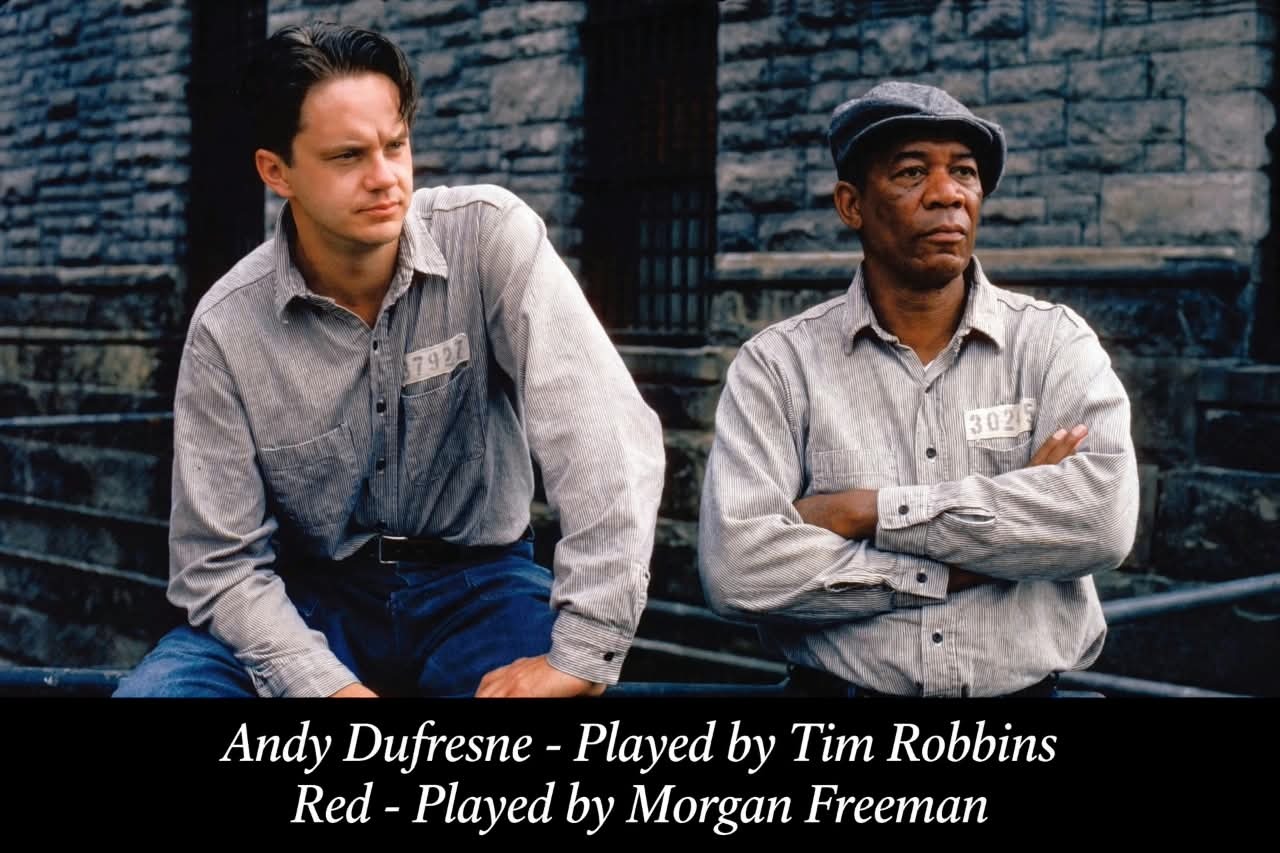
The story begins with Andy Dufresne, portrayed by Tim Robbins, a banker sentenced to life imprisonment for the murder of his wife and her lover. From the opening moments, the film confronts us with the harsh reality of prison life: a world governed by towering walls, relentless surveillance, and an authority that does not hesitate to employ violence to impose its will.
Perhaps more than any other place, prisons reveal how societies truly regard human beings and how deeply they respect human dignity and rights. Regardless of the crime committed, a prisoner remains a human being whose fundamental rights should not be taken away. Yet Shawshank presents the opposite reality. Within its walls, the values of justice and fairness steadily deteriorate, and the individual becomes little more than a number in the records of a penal institution.
Upon his arrival, Andy meets Red, a seasoned inmate portrayed by Morgan Freeman. We hear Red’s voice in a voice-over as he recalls his first impressions of the newcomer, a man unlike the other prisoners in his composure, manner, and outlook on the world.
Morgan Freeman delivers an exceptionally distinguished performance, supported by his remarkably expressive features and his rare ability to convey the most delicate emotions without exaggeration. In terms of expressive presence and emotional depth, I have long regarded him as a darker-skinned counterpart to Anthony Quinn, particularly in Quinn’s extraordinary performance in Zorba the Greek. Both actors possess that rare gift through which the human face alone can tell an entire story.
Norton: The Bible in His Hand, Corruption in His Heart
Warden Norton welcomes the new inmates with a Bible in his hands and proceeds to lay down his own rules, as though presenting them with a moral constitution from which no one is permitted to deviate:
“Rule number one: No blaspheming or disrespecting religion and sacred things. I will not tolerate anyone taking the Lord’s name in vain. Put your trust in the Lord, and the other rules will be made known to you during your stay here.”
From that moment, the great contradiction at the heart of Norton’s character begins to emerge. He does not merely manage the prison; he presents himself as the shadow of God, using religious language to sanctify his authority. He holds the Bible as though it were his personal possession, granting himself the right to interpret and employ its words according to his own interests.
In his luxurious office hangs a painting made by his wife, bearing a biblical inscription: “His judgment cometh soon.” Yet the cruelest irony is that the painting conceals a safe containing the money he has stolen from charitable donations.
It is a striking portrait of corruption dressed in the garments of virtue. Sacred words become a cover for theft, while moral preaching is transformed into a means of concealing crime.
In one scene, a prisoner collapses after being brutally beaten by Officer Hadley, who shows no hesitation in using excessive violence against him. The prisoner eventually dies in the prison infirmary without receiving the care or medical attention he needs.
At this point, Shawshank ceases to be merely a place where sentences are served. It becomes an institution in which the most fundamental principles upon which the law is supposed to rest are systematically violated.
Andy: The Mind Against Brutality
During his early years in prison, Andy is repeatedly assaulted and brutally beaten by a group of inmates led by Bogs. This represents another face of cruelty. Alongside the tyranny of authority, there is the violence that prisoners inflict upon one another in an environment where protection and justice have all but disappeared.
Red, meanwhile, maintains a network of connections and acquaintances that enables him to obtain various goods and necessities inside the prison.
On one occasion, Red arranges for himself, Andy, and a group of fellow inmates to be assigned the task of coating the roof of one of the buildings with tar. While they are working, Andy overhears Officer Hadley discussing a tax problem involving his money. Andy immediately offers his banking expertise, suggesting that Hadley give part of his money to his wife as a gift, since gifts, as Andy explains, are not subject to income tax in the same way.
That encounter marks a turning point in Andy’s life behind bars. The guards begin to realize that the man who entered Shawshank accused of murder possesses an exceptional financial mind and banking expertise capable of solving their financial problems.
Before long, his services extend to most of the guards and eventually to the warden himself. Andy begins preparing financial statements and tax returns, finding in this new responsibility a measure of protection from the assaults that had haunted his early years in prison.
But this protection comes at a price. He gradually finds himself entangled in the network of illegal activities operated by Norton, foremost among them money laundering and the concealment of illicit wealth.
The warden keeps his documents, contracts, and records in his office, while Andy creates a fictitious identity behind which Norton can legally conceal himself, conducting his financial operations without revealing his true identity.
Thus, Andy, who entered prison as the victim of a wrongful accusation, becomes part of a corrupt system administered by the very man who preaches justice and virtue.
Music: An Open Window in the Prison Wall
Andy refuses to surrender to the belief that prison can confiscate his mind and spirit forever. He continues to believe that a person can preserve inner freedom even when physical freedom has been taken away.
Guided by this conviction, he begins writing repeatedly to the state legislature, requesting a budget allocation to support the prison library and provide it with books and reference materials.
The response does not come easily. His repeated efforts initially bring him little more than endless waiting. Yet he persists, writing with determination until the day finally arrives when he receives hundreds of books and several music records.
While arranging the books in the warden’s office, his eyes fall upon a recording of Mozart’s opera The Marriage of Figaro.
He pauses, as though he has discovered a small window opening onto another world, a world unknown to prison bars and beyond the reach of towering walls.
He locks the office doors and plays the music over the prison’s public-address system.
Suddenly, Mozart’s melodies reverberate throughout Shawshank. The music flows into the cells, corridors, and courtyards, granting the prisoners rare moments of beauty and freedom in a world where they have grown accustomed to hearing commands, shouting, and the heavy footsteps of guards.
Norton rushes to the office and orders Andy to turn off the music immediately. But Andy chooses a quiet act of defiance, raising the volume even higher and openly challenging the warden’s authority.
Hadley then breaks down the door, arrests Andy, and sends him to solitary confinement.
That scene is far more than a mere violation of prison regulations. For a brief moment, it represents the triumph of the human spirit over oppression. The music, which the prison bars could not silence, reveals that there are spaces within the human soul that no authority can reach, however cruel it may be.
Tommy: When Truth Becomes a Threat
As the 1960s begin, a new inmate arrives at Shawshank, a young man named Tommy, portrayed by actor Gil Bellows.
Tommy’s arrival brings a crucial development to the story. He tells the inmates that, while serving time in another prison, he met a criminal who confessed to murdering Andy’s wife and her lover, revealing that Andy had paid the price for a crime he had never committed and had been imprisoned in place of the real murderer.
The revelation is a long-awaited glimmer of hope. After years of suffering, a testimony has finally emerged that could uncover the truth and restore the dignity of a man who has spent his life behind bars for a crime he did not commit.
Andy hastens to inform Norton of what he has learned and asks for his assistance in proving his innocence.
But Norton does not view the matter through the lens of justice or truth. He understands that Andy’s release would mean losing the very man who manages his illegal financial operations and knows the secrets of his accounts, documents, and fictitious identity.
More dangerously still, once free, Andy could reveal everything he knows about the warden’s corruption and criminal activities.
Thus, truth itself becomes a threat to the interests of power, and the man seeking justice becomes a new target—not because he has committed a crime, but because he possesses the ability to expose a far greater one.
Indeed, the unfolding events lead the viewer to suspect that Norton might even contemplate having Andy killed, thereby eliminating once and for all any threat that could expose his theft and financial crimes.
Tommy’s Murder: When Truth Is Assassinated
Norton decides to put an end to anything that might threaten his small empire within the prison. He sends Andy to solitary confinement for an entire month.
While Andy remains in isolation, the warden summons young Tommy to the prison yard at night.
In a sudden and shocking moment, one of the guards raises his rifle, aims at Tommy, and fires. The young man falls dead.
Norton enters the scene, pauses for a moment before the young man’s body, casts a cold glance at his victim, and then walks away.
This is no ordinary murder within prison walls. It is a declaration that authority is prepared to sacrifice any human life—even to assassinate truth itself—when its interests are threatened.
Here, the conflict reaches its climax. After spending twenty years unjustly imprisoned, Andy realizes that the possibility of regaining his freedom through legal channels has become almost nonexistent. The issue is no longer simply a matter of proving his innocence; he must confront a man who controls punishment, manipulates evidence and witnesses, and does not hesitate to eliminate anyone who stands in his way.
Andy becomes certain that Norton will never allow him to leave the prison alive if he believes that Andy’s freedom will bring about his own downfall.
The Tunnel: The Road to Freedom
After all those years of patience and struggle, Andy begins to put his final plan into action.
Using a small rock hammer, he succeeds in digging a tunnel extending from his cell to the outside of the prison. It is a long and exhausting undertaking, carried out secretly over the years and beyond the watchful eyes of the guards.
The tunnel represents far more than a means of escape. It is the fruit of twenty years of patience and determination, and a testament to the faith of a man who never allowed despair to defeat him.
Andy finally makes his way out of the prison through a sewage pipe, embarking upon a harsh journey toward freedom and leaving behind a world that had believed it would hold him captive forever.
Once outside, he takes possession of the money Norton has accumulated through his money-laundering operations. Using the fictitious identity he created for the warden, Andy forges identification documents and a passport, then transfers the money into his offshore accounts.
The very tools Norton had used to conceal his crimes are now turned against him. The fictitious identity Andy created as a cover for corruption becomes the instrument through which Norton is exposed and ultimately brought down.
Before disappearing, Andy leaves a package for the warden.
When Norton opens it, he discovers the Bible he had so proudly displayed, hollowed out to conceal the small hammer Andy had used to dig his way to freedom.
What a powerful symbolic irony!
The Bible Norton had used as a façade for his corruption becomes the very object that reveals how a prisoner managed to wrest his freedom from his grasp. And the little hammer, seemingly insignificant in the eyes of others, becomes the instrument that brings down his closed and oppressive world.
From Shawshank to the Shores of Mexico: The Triumph of Hope
Andy makes his way to Mexico, fulfilling a promise he had made to his friend Red before his escape. It is a promise he has carried in his heart throughout the years of imprisonment, a window onto a different future and a dream he refuses to abandon.
Some time later, Red also succeeds in breaking free from his confinement and joins his friend Andy on the shores of Mexico.
There, beneath an open sky and beside an endless ocean, the two men are reunited after years of deprivation, oppression, and isolation.
There are no longer any bars separating them, no iron doors controlling their movements, and no guards whose footsteps interrupt their moments of silence.
At last, they have reached the place Andy had dreamed of for so long—a place where a human being can breathe without fear and gaze toward the horizon without walls standing in the way.
The film’s ending is not merely the victory of two men over a cruel prison. It is the triumph of a far deeper human value: hope that refuses to die, even when the entire world seems determined to extinguish it.
Andy succeeds in reclaiming his freedom from an institution that possessed his body for twenty years but could never possess his mind, confiscate his dreams, or extinguish his faith in the future.
This is where the true greatness of The Shawshank Redemption lies. It reminds us that the most dangerous prisons are not always those surrounded by towering walls. Some are built within human souls and societies when justice disappears, truth is held captive, and the law becomes an instrument in the hands of those who are supposed to protect it.
Freedom may be delayed, justice may be besieged, and truth may remain buried for years. Yet hope retains the power to carve its own path, even through the strongest of walls.